

Everyday Collection
For savoring the everyday.
A collection of objects that bring calm and joy into your home and your routines; pieces that invite you to pause and find wonder in small moments.
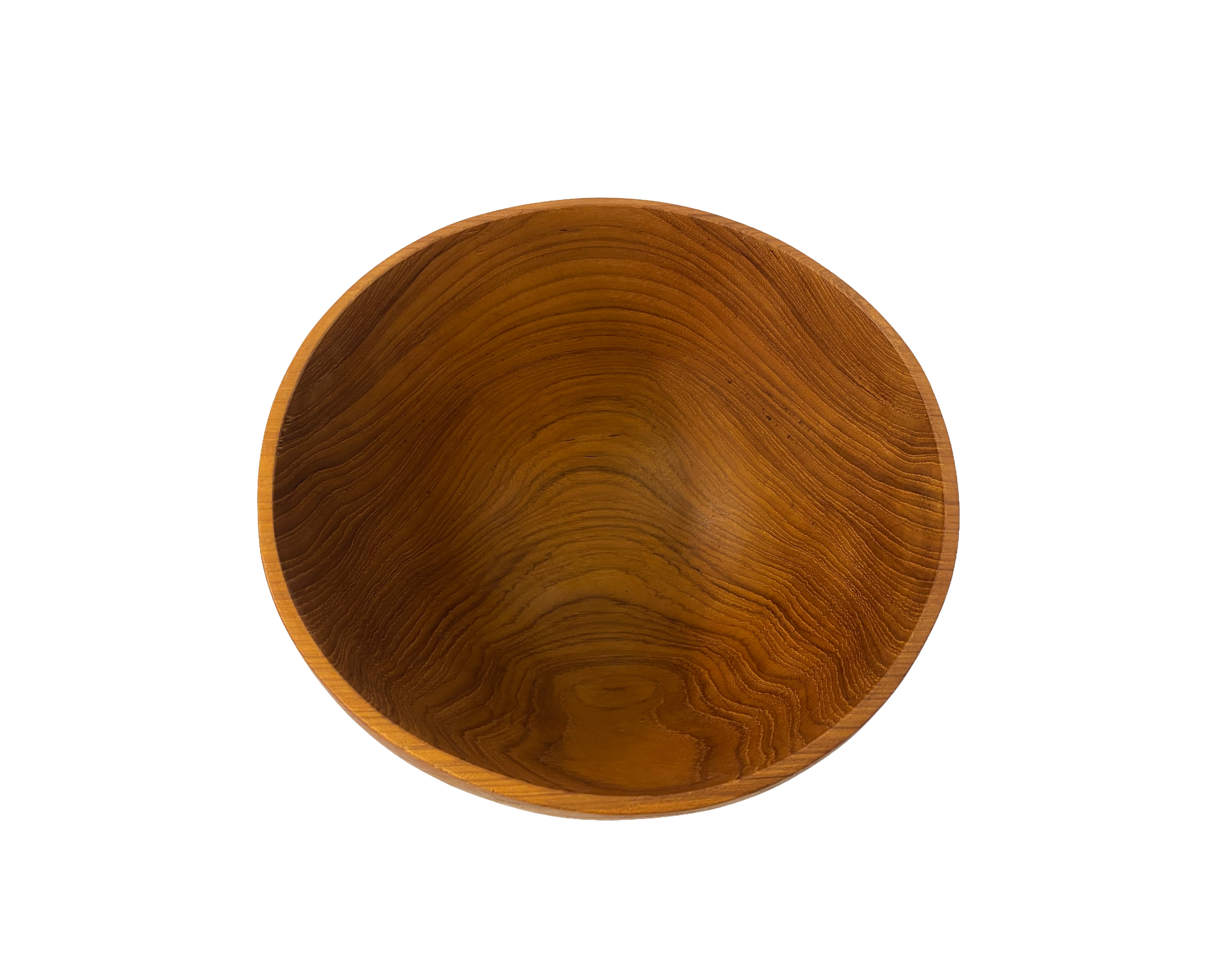
This hand-turned Danish teak bowl embodies the sculptural elegance of mid-century modern design. Broad at the rim and tapering to a narrower base, its proportions balance strength and lightness, allowing the material itself to shine. The teak has developed a deep, even patina over the decades, its grain has grown warm and luminous with age.
Teak was the favored wood of Danish designers in the 1950s and ’60s. They valued it for its durability, rich color, and natural oils, which allowed pieces like this to withstand decades of daily use. Danish designers often sourced teak from former colonial trade routes in Southeast Asia. Teak thus carried a dark global history into Scandinavian workshops, linking Nordic modernism with tropical resources.
Spring Moon acquired this example in Berlin from an Italian merchant who specializes in 20th-century design. Its journey—from Southeast Asia to the hands of a Danish turner in the 1960s, through decades of private use, to an Italian dealer in Berlin—mirrors the international circulation of Scandinavian modernism itself. Today, it stands as both a functional object and a piece of design history.
Origin: Denmark, circa 1960
Material: Hand-turned teak wood
Style: Mid-Century Modern
Dimensions: 9.8 in x 6 in x 4.5 in (25 cm x 6 cm x 12 cm)
Weight: 2 lbs (907 grams)
Condition: Excellent vintage patina

This mid-century French aneroid barometer was designed for maritime use, measuring atmospheric pressure to guide sailors through changing conditions at sea. Its polished round wooden frame—possibly teak, in a warm honey tone—holds a dial inscribed with words that feel as evocative as they are practical: Tempête (storm), Pluie (rain), Variable, Beau (fair), Très Sec (very dry). At once scientific and poetic, they gesture not only to weather but also to our own states of well-being.
The design itself is classic mid-century modern: simple, functional, and elegant, with a small hook at the top for mounting. It reflects the ethos of its era, where form followed function, but with enough grace to make the everyday beautiful.
The aneroid barometer, notably, was itself a French invention: in 1843 Lucien Vidie created the first mercury-free pressure gauge, a revolution in portability and durability. Instruments like this one embody that lineage of innovation, adapted for shipboard use and, today, for domestic contemplation.
Spring Moon acquired this example in Paris, in a funky art gallery and antique dealer near the Jardin du Luxembourg. It carries with it the city’s charm as well as the sea’s restless poetry: an object of guidance, balance, and quiet beauty.
Origin: Paris, France, Mid-Century
Materials: Metal and wood
Dimensions: 5 in x 1.5 in (13 cm x 4 cm)
Weight: 12 oz (340 grams)
Condition: Good vintage condition, light wear consistent with age

This charming teal-blue glass candy dish, shaped like a bird, combines whimsy, nostalgia, and a touch of history. We discovered it in a small Tröddel Market in Berlin, sold by two gruff-on-the-surface yet kind-hearted women—possibly sisters—whose shop closed not long afterward, making this a rare find.
Bird and animal-shaped glass candy dishes have a long tradition. The most famous examples, “Hens on Nests,” date back to the late 19th century, while other animal forms grew popular in the 1920s and 1930s as mass-manufacturing techniques in Germany and the United States improved. Small, sculptural, and decorative, these pieces were designed to bring charm and a touch of nature to everyday tables.
For us at Spring Moon, this little dish’s gentle curves and vibrant teal hue evoke the serene beauty of Berlin’s lakes, the delight of bluebirds in flight, and the simple joy of sneaking a few sweets from a dish on Grandma’s table. Small yet sculptural, it’s perfect for displaying candies, trinkets, or even as a standalone decorative accent.
Origin: Berlin, Germany, 20th century
Material: Teal-colored glass
Dimensions: 6.5 in x 3 in (16.5 cm x 7.5 cm)
Weight: 12 oz (340 grams)
Condition: Excellent, no chips or cracks
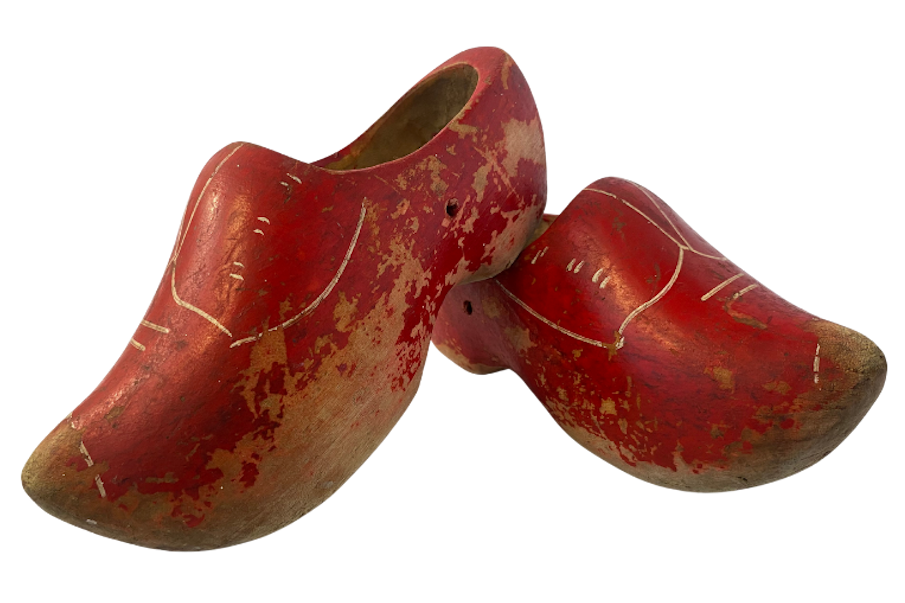
Hand-carved from solid wood and painted a now-weathered red, these Swedish children’s clogs carry the marks of a life well lived. Their chipped paint and worn soles show clear signs of use—beloved, practical shoes once worn daily.
We acquired them in Örback, Sweden, from one of the oldest houses in the village, built in 1880. Once the largest farm in the area, the property later became a “children’s colony”—a uniquely Swedish institution that combined aspects of summer camp, orphanage, and TB sanatorium. The clogs likely passed through many hands, each step adding to their history.
Clogs (träskor) have been central to Swedish rural life for centuries. Worn by farmers, children, and workers, they were valued for their durability and simplicity. Painted versions, often in red or black, were common in the countryside, given to children for everyday wear or on special occasions.
Origin: Örback, Sweden, Late 19th century
Materials: Wood and paint
Dimensions: 9 in x 4 in x 3.25 in (23 cm x 10 cm x 8 cm)
Weight: 1 lb (450 grams)
Condition: Worn, with scratches and patina consistent with extensive use

Carved in the playful outline of an apple, this mid-century teak bowl brings together sculptural simplicity and everyday charm. Measuring 5.75 inches across and 2 inches high, it is hand-carved with gentle curves that highlight the natural grain and warmth of the wood.
We discovered this bowl at a Sunday flea market in Berlin, alongside other mid-century treasures such as Marimekko curtains. Its apple form evokes both school lunches and grandmother’s kitchen: apples as shorthand for what is wholesome, nourishing, and enduring. At once practical and symbolic, it offers a touch of mid-century modern wit while remaining timelessly functional.
Perfect for holding fruit, nuts, or simply admired on its own, the bowl speaks to an era when even modest household objects were designed with care.
Origin: Berlin, Germany, Mid-Century
Material: Teak wood
Dimensions: 5.75 in x 5.75 in x 2 in (14.5 cm x 14.5 cm x 5 cm)
Weight: 5 oz (140 grams)
Condition: Excellent vintage condition, light wear consistent with age

Handcrafted in Tokyo by the 190-year-old family business Shirokiya Denbei Shoten, following techniques unchanged since the Edo period, this unique broom embodies both utility and purity; it’s a gentle call to mindfulness and patience in domestic everyday life.
The broom is made from carefully selected houki morokoshi grass, chosen for its soft resilience, lightweight center, and ease of use. The broom’s distinctive construction allows it to sweep corners, stairs, wooden floors, and even delicate surfaces like carpets with surprising efficiency.
Beyond their functional elegance, Edo brooms carry cultural and spiritual resonance. In Japan, brooms are associated with purity and care; we were reminded of this while visiting the Moss Temple in Kyoto, where we observed a monk sweeping leaves from the moss with patient, meditative precision.
Because they do not ship overseas, we purchased these brooms in person from the family-run shop. The shop’s kind staff demonstrated how to use them, sharing subtle techniques for sweeping and dusting delicate surfaces.
Origin: Shirokiya Denbei Shoten family-run business in Tokyo, Japan
Materials: Houki morokoshi grass
Dimensions: 11 in x 4.5 in (28 cm x 11 cm)
Weight: 2.5 oz (70 grams)
Condition: New
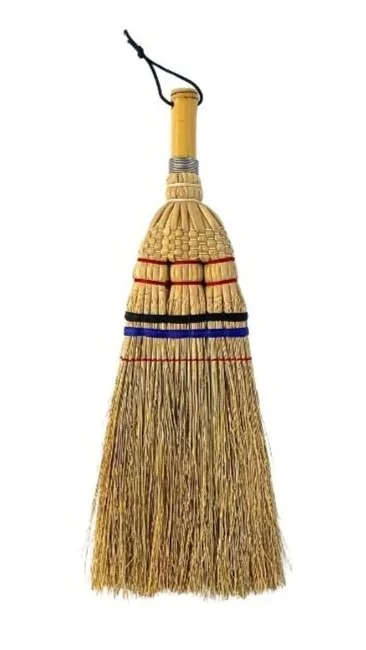
Handcrafted in Tokyo by the 190-year-old family business Shirokiya Denbei Shoten, following techniques unchanged since the Edo period, this unique broom with woven detail embodies both utility and purity; it’s a gentle call to mindfulness and patience in domestic everyday life.
The broom is made from carefully selected houki morokoshi grass, chosen for its soft resilience, lightweight center, and ease of use. The broom’s distinctive construction allows it to sweep hard surfaces like stone and wood floors and even delicate surfaces like area rugs with surprising efficiency.
Beyond their functional elegance, Edo brooms carry cultural and spiritual resonance. In Japan, brooms are associated with purity and care; we were reminded of this while visiting the Moss Temple in Kyoto, where we observed a monk sweeping leaves from the moss with patient, meditative precision.
Because they do not ship overseas, we purchased these brooms in person from the family-run shop. The shop’s kind staff demonstrated how to use them, sharing subtle techniques for sweeping and dusting delicate surfaces.
Origin: Shirokiya Denbei Shoten family-run business in Tokyo, Japan
Materials: Houki morokoshi grass
Dimensions: 14 in x 6 in (36 cm x 14 cm)
Weight: 4 oz (110 grams)
Condition: New

Handcrafted in Yame, on Japan’s southern island of Kyushu, this paper lamp carries the centuries-old tradition of chochin lanterns. Made by Cocolan artisans from Japanese washi paper and wood, in a shape that honors the region’s surrounding mountains, it offers a quiet, ambient glow—perfect for intimate dining, a bedside table, or desk.
We discovered these lamps while staying in Yame, a former merchant town known for its hillside green-tea plantations and indigo-dye workshops. Our inn, a renovated 1902 sake brewery and tea house, was softly lit with these small lamps. In the evening their gentle glow illuminated the hallways and our table. Enchanted, we sketched them, wondering about their providence, only to stumble the next morning upon a nearby shop where a woman sat painting delicate flowers on the shades. We bought two lamps on the spot, one of which we are offering here.
The lamp is individually hand-assembled and shipped fully intact. Because it cannot be disassembled without damage, we prepare it with extra protective wrapping to ensure it arrives safely.
Maker: Handcrafted by Cocolan artists
Origin: Yame, Japan
Materials: Washi paper lantern and wood base, cordless with LED light
Dimensions: 5.5 in x 4.3 in (14 cm x 11 cm)
Weight: 3 oz (85 grams)
Note: Ships fully assembled with protective wrapping.

Handcrafted in Tokyo by the 190-year-old family business Shirokiya Denbei Shoten, following techniques unchanged since the Edo period, this small broom bound with red-and-black ribbons embodies both utility and purity; it’s a gentle call to mindfulness and patience in domestic everyday life.
The broom is made from carefully selected houki morokoshi grass, chosen for its soft resilience, lightweight center, and ease of use. The broom’s distinctive construction allows it to sweep tight corners and even delicate surfaces like laptops with surprising efficiency.
Beyond their functional elegance, Edo brooms carry cultural and spiritual resonance. In Japan, brooms are associated with purity and care; we were reminded of this while visiting the Moss Temple in Kyoto, where we observed a monk sweeping leaves from the moss with patient, meditative precision.
Because they do not ship overseas, we purchased these brooms in person from the family-run shop. The shop’s kind staff demonstrated how to use them, sharing subtle techniques for sweeping and dusting delicate surfaces.
Origin: Shirokiya Denbei Shoten family-run business in Tokyo, Japan
Materials: Houki morokoshi grass
Dimensions: 6 in x 4 in (15.5 cm x 10 cm)
Weight: 2 oz (55 grams)
Condition: New
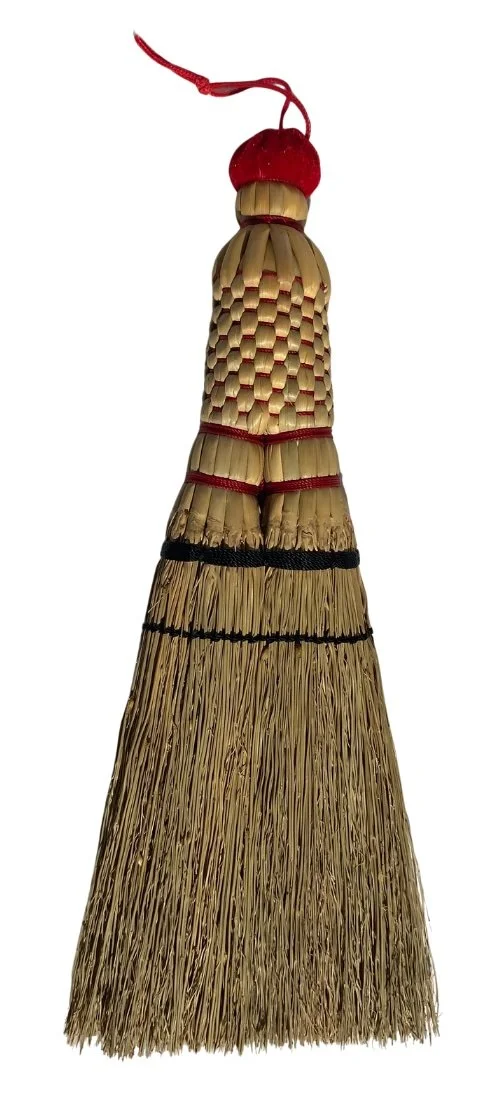
Handcrafted in Tokyo by the 190-year-old family business Shirokiya Denbei Shoten, following techniques unchanged since the Edo period, this red capped-broom embodies both utility and purity; it’s a gentle call to mindfulness and patience in domestic everyday life.
The broom is made from carefully selected houki morokoshi grass, chosen for its soft resilience, lightweight center, and ease of use. The broom’s distinctive construction allows it to sweep hard surfaces like stone and wood floors and even delicate surfaces like area rugs with surprising efficiency.
Beyond their functional elegance, Edo brooms carry cultural and spiritual resonance. In Japan, brooms are associated with purity and care; we were reminded of this while visiting the Moss Temple in Kyoto, where we observed a monk sweeping leaves from the moss with patient, meditative precision.
Because they do not ship overseas, we purchased these brooms in person from the family-run shop. The shop’s kind staff demonstrated how to use them, sharing subtle techniques for sweeping and dusting delicate surfaces.
Origin: Shirokiya Denbei Shoten family-run business in Tokyo, Japan
Materials: Houki morokoshi grass
Dimensions: 12 in x 5 in (30 cm x 12 cm)
Weight: 4 oz (110 grams)
Condition: New

Handcrafted in Tokyo by the 190-year-old family business Shirokiya Denbei Shoten, following techniques unchanged since the Edo period, this small green broom embodies both utility and purity; it’s a gentle call to mindfulness and patience in domestic everyday life.
The broom is made from carefully selected houki morokoshi grass, chosen for its soft resilience, lightweight center, and ease of use. The broom’s distinctive construction allows it to sweep tight corners and even delicate surfaces like laptops with surprising efficiency.
Beyond their functional elegance, Edo brooms carry cultural and spiritual resonance. In Japan, brooms are associated with purity and care; we were reminded of this while visiting the Moss Temple in Kyoto, where we observed a monk sweeping leaves from the moss with patient, meditative precision.
Because they do not ship overseas, we purchased these brooms in person from the family-run shop. The shop’s kind staff demonstrated how to use them, sharing subtle techniques for sweeping and dusting delicate surfaces.
Origin: Shirokiya Denbei Shoten family-run business in Tokyo, Japan
Materials: Houki morokoshi grass
Dimensions: 4 in x 2.5 in (10 cm x 6 cm)
Weight: 0.5 oz (14 grams)
Condition: New

Woven Histories: Textiles and Modern Abstraction traces how weaving, embroidery, and fiber work became vital forms of modernist expression—equal in rigor and innovation to painting and sculpture.
Edited by Lynne Cooke, Senior Curator at the National Gallery of Art, the book gathers over fifty artists, from early visionaries such as Anni Albers, Sophie Taeuber-Arp, and Sonia Delaunay to contemporary makers including Sheila Hicks, Rosemarie Trockel, and Jeffrey Gibson. Across 190 color plates and a series of illuminating essays, Woven Histories restores textiles to their rightful place at the center of modern creativity.
We first encountered the exhibition by chance while en route to see a Whistler portrait at the National Portrait Gallery in Washington, D.C., and were so captivated we sought it out again when it traveled to the Museum of Modern Art in New York.
While photographs can’t fully capture the scale and intricacy of the works on display, the book stands beautifully on its own. Cooke’s introduction traces the intertwined history of textiles and abstraction and concludes on a note that feels especially aligned with our own ethos, recognizing how artists and craftspersons past and present have sought, through thread and design, to imagine a better world.
About the Author:
Lynne Cooke is Senior Curator of Special Projects in Modern Art at the National Gallery of Art in Washington, D.C. She holds a PhD in art history from the University of London, and her writing has appeared in Burlington Magazine and Artforum.
Publisher: National Gallery of Art and the University of Chicago Press, 2023
Format: Hardcover, 292 pages
Dimensions: 9.5 in x 11 in (24 cm x 28 cm)
Condition: New

First published in 1965, this expanded edition of On Weaving by Anni Albers reintroduces one of the twentieth century’s most important design texts, now featuring full-color photographs and essays by Nicholas Fox Weber, Manuel Cirauqui, and T’ai Smith.
Anni Albers, who trained at the Bauhaus and later taught at Black Mountain College, explores weaving as both structure and language, an “event of threads” that bridges handcraft and the machine-made. She opens the book with a simple, reverent dedication: “To my great teachers, the weavers of ancient Peru.” The gesture is telling: her work is grounded in humility and respect for the long, global histories of textile making.
The book itself is a sensual pleasure to peruse. The close-up photographs of fibers, knots, and woven patterns—alongside her own sketches and material studies—are mesmerizing. Together, they invite the reader into the rhythm and intelligence of the hand at work.
We discovered this volume after seeing Weaving Abstraction in Ancient and Modern Art, where Albers’s textiles appeared alongside ancient Andean works and those of Sheila Hicks, Lenore Tawney, and Olga de Amaral. Seeing her work in that context—and later in Woven Histories—transformed our sense of weaving as a modern art form: one that binds civilizations across time and geography.
About the Author:
Anni Albers (1899–1994) was a pioneering textile artist, designer, and teacher. Trained at the Bauhaus and later a founding faculty member at Black Mountain College, she redefined weaving as a modern art form that united utility, abstraction, and poetic precision.
Publisher: Princeton University Press, 2018
Format: Hardcover, 272 pages
Dimensions: 8.5 in x 11 in (22 cm x 28 cm)
Condition: New

In Every Living Thing, Jason Roberts traces the intertwined lives of two eighteenth-century naturalists who set out to name all of life on Earth: Carl Linnaeus in Sweden and Georges-Louis de Buffon in France. Linnaeus sought to impose order and hierarchy, giving us the terms mammal, primate, and Homo sapiens. Buffon, by contrast, saw nature as restless and ever-evolving. Their rivalry helped shape the birth of modern biology and continues to influence how we perceive and classify the living world.
We first discovered this book in the shop of Berlin’s Museum of Natural History. Once named for Alexander von Humboldt—the city’s great naturalist and explorer whose Kosmos sought to unite all forms of knowledge—the museum felt like the perfect setting for this story. Beneath its vast dinosaur skeletons, Every Living Thing seemed right at home: a reminder that the urge to name, order, and understand the world is as much about wonder as it is about power.
Roberts writes with clarity and verve, transforming scientific history into a suspenseful human drama. Linnaeus and Buffon emerge as vivid, complex figures: products of their age and participants in a wider European project to name, claim, and control knowledge about the natural world as exploration and colonization expanded.
About the Author:
Jason Roberts is the author of A Sense of the World: How a Blind Man Became History’s Greatest Traveler. His writing has also appeared in McSweeney’s and The Believer.
Publisher: Random House, 2025
Format: Softcover, 432 pages
Dimensions: 5 in x 8 in (13 cm x 20 cm)
Condition: New

A Book of Noises is an invitation to listen more deeply to the world, to one another, and to the hum of existence itself.
British writer and journalist Caspar Henderson turns his boundless curiosity toward sound, exploring what it reveals about being alive. In a series of short essays arranged around four categories: anthropophony (human sound), biophony (the sounds of other life), geophony (the planet), and cosmophony (space), he moves fluidly from “Sound in Space” to “Plants,” “Volcano,” and “Bells,” weaving the scientific, the historical, and the personal with elegance and humor.
One essay describes a vine in the rainforests of Cuba whose bowl-shaped leaves help bats find its flowers faster than other plants, an acoustic alliance that ensures pollination. Such moments illuminate Henderson’s larger meditation: that sound connects species, worlds, and ways of knowing.
Against a culture dominated by the visual, A Book of Noises reawakens the ear and the imagination. Since discovering it on the shelves of the Natural History Museum in Berlin, we’ve been listening differently, hearing the clatters, clicks, and buzzes of the natural world, reminding us that we are never alone.
About the Author:
Caspar Henderson is a British journalist and writer based in Oxford. He is also the author of A Book of Barely Imagined Beings: A 21st Century Bestiary (2013) and A New Map of Wonders: A Journey in Search of Modern Marvels (2017).
Publisher: University of Chicago Press, 2023
Format: Softcover, 272 pages
Dimensions: 5.5 in x 8.5 in (14 cm x 22 cm)
Condition: New

The Beauty of Everyday Things by Soetsu Yanagi holds a special place in the Spring Moon Design collection: an honored source of inspiration. This volume gathers sixteen essays by Soetsu Yanagi (1889–1961), philosopher, art historian, and founder of Japan’s folk craft movement (mingei). Writing in an age of rapid westernization and modernization in 1920s Japan, Yanagi argued that humble, functional objects, made by anonymous craftspeople for everyday use, were more beautiful and ultimately superior to ornate works or mass-produced goods.
His notion of good design feels modern in its call for natural materials, simple design, and harmony with nature:
Nature tells us the shape and patterns a material should assume, and nothing good can be achieved by ignoring its dictates. A good artisan seeks nothing that nature does not seek.
His writing is a reminder to value objects that emerge from tradition and necessity, carrying with them the histories and rhythms of human life. Both philosophical and deeply practical, The Beauty of Everyday Things encourages us to slow down, to attend to the objects that shape daily life, considering their links to nature—or estrangement, if that is the case—and to the histories and hands that brought them into being.
About the Author:
Soetsu Yanagi (1889–1961) was the founder of the Japanese folk crafts movement (mingei) and the first director of Tokyo’s Japan Folk Crafts Museum (1932). He brought his philosophy of craft to international audiences, including a 1952 pottery seminar at Black Mountain College in the United States.
About the Translator:
Michael Brase (1943-2021) was an editor, author, and translator. Originally from Fresno, California, Brase moved to Japan as a young adult, where he later became a citizen, working as an editor for leading publishing houses of English translations of Japanese books about art and literature.
Publisher: Penguin Books, 2017
Format: Softcover, 272 pages
Dimensions: 4.5 in x 7 in (11.5 cm x 18 cm)
Condition: New

Reading Bashō: The Complete Haiku feels like stepping into a landscape both distant and familiar, where a butterfly’s shadow or the fragrance of flowers carried by the wind become a bridge across centuries. This softcover bilingual edition gathers every known poem by Japan’s most celebrated haiku master, accompanied by an illuminating introduction by translator Andrew Fitzsimmons.
As Fitzsimmons points out in his insightful introduction, Japanese haiku was not a solitary pursuit but a communal art: many of Bashō’s verses were composed as greetings, farewells, or tokens of friendship. Even his name, Bashō (banana plant), was based on a gift from a friend.
We discovered this collection while studying Japanese and preparing for a stay in Japan. Having long admired the Tang poets of China, we were struck by how Bashō’s brief poems like “A lone butterfly / aflutter over a field / over its shadow” connect us, across language and time, through the delicate noticing of the natural world.
About the Author:
Matsuo Bashō (1644–1694) is Japan’s greatest and most famous poet. Born into the Samurai class in a town not far from Kyoto, Japan, he later moved to Edo, modern Tokyo, where he studied Chinese poetry, Taoism, and Zen Buddhism and cultivated a community of friends and admirers that helped to establish haiku as the dominate form of poetic expression in Japan.
About the Translator and Editor:
Andrew Fitzsimons is the author of The Sea of Disappointment: Thomas Kinsella’s Pursuit of the Real and a Professor of English Language and Cultures at Gakushuin University, Tokyo.
Publisher: University of California Press, 2022
Format: Softcover, bilingual edition (Japanese-English), 472 pages
Dimensions: 5 in x 7.5 in ( 13 cm x 19 cm)
Condition: New
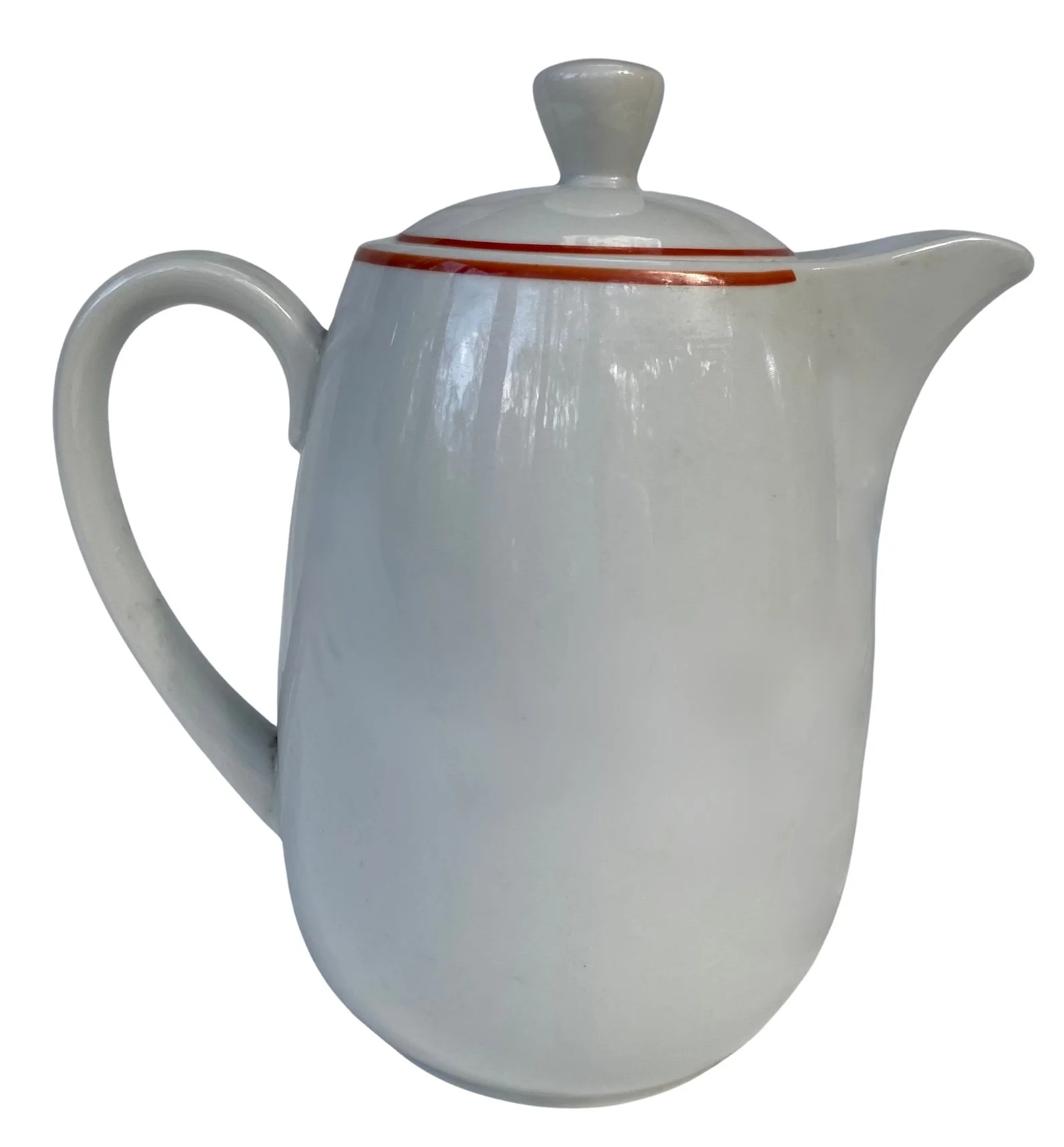
This white porcelain pitcher or coffee pot, accented by a fine orange-red line circling its rim, carries with it a bit of mystery. Acquired in Berlin from a woman uncertain of its origins, the piece bears no maker’s mark, yet its form and restrained elegance evoke the designs of Mitropa, the East German railway catering company.
Founded in 1916, Mitropa was long associated with modern, functional tableware designed for use on trains, ferries, and in station restaurants. In 1969, the company introduced its Rationell Line(designed by Margarete Jahny and Erich Müller), a service rooted in the Bauhaus legacy: clean, utilitarian forms made with an eye toward both durability and refinement. Contrary to the common myth that the German Democratic Republic stood apart from postwar design currents, the Rationell Line reflected the communist country’s turn in the mid-1960s toward adapting modernist sensibilities as fully as its capitalist counterparts.
The slight signs of wear only add to its authenticity, reminding us that this sleek pitcher was not made to be admired behind glass but to serve in the rituals of everyday life.
Origin: Berlin, Germany, 20th century, likely late 1960s, early 1970s
Materials: White porcelain with orange-red rim detail
Dimensions: 8 in x 7 in (20 cm x 18 cm), without lid and handle
Weight: 2 lbs (900 grams)
Condition: Good vintage condition, with slight signs of wear
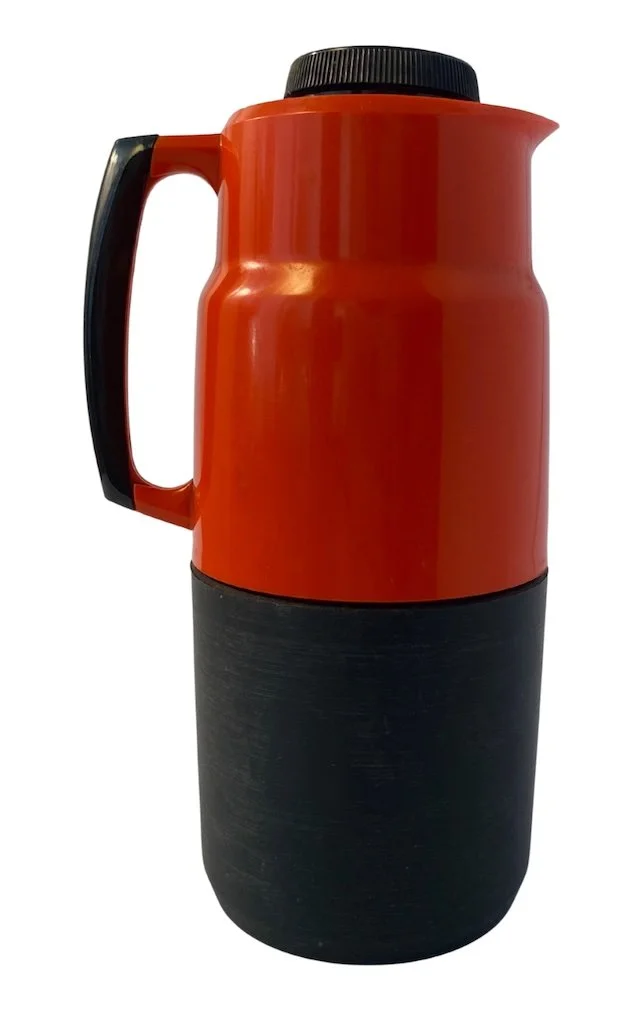
This vibrant 1970s Swedish thermos reflects the clarity and practicality of mid-century Swedish design. Though its maker is unknown, its bold orange-and-black style is reminiscent of celebrated designs of the era, when Swedish designers prioritized affordable, functional, and modern objects—keeping coffee warm while you worked, yet designed with elegance in mind.
We discovered this piece in a vintage shop in Stockholm and later noticed a similar example at the Stockholm Museum of Modern Art.
The thermos is made from mid-century plastic, a material once celebrated for convenience and affordability. Today, we recognize its environmental cost—but rather than discard vintage pieces, we celebrate their design by giving them a new purpose. In this way, functional objects can continue to inspire beauty and mindfulness without producing more waste.
Origin: Stockholm, Sweden, 1970s
Material: Plastic
Dimensions: 8.5 in x 4 in (22 cm x 10 cm), without lid and handle
Weight: 1 lb (450 grams)
Condition: Excellent vintage condition, minor wear consistent with age
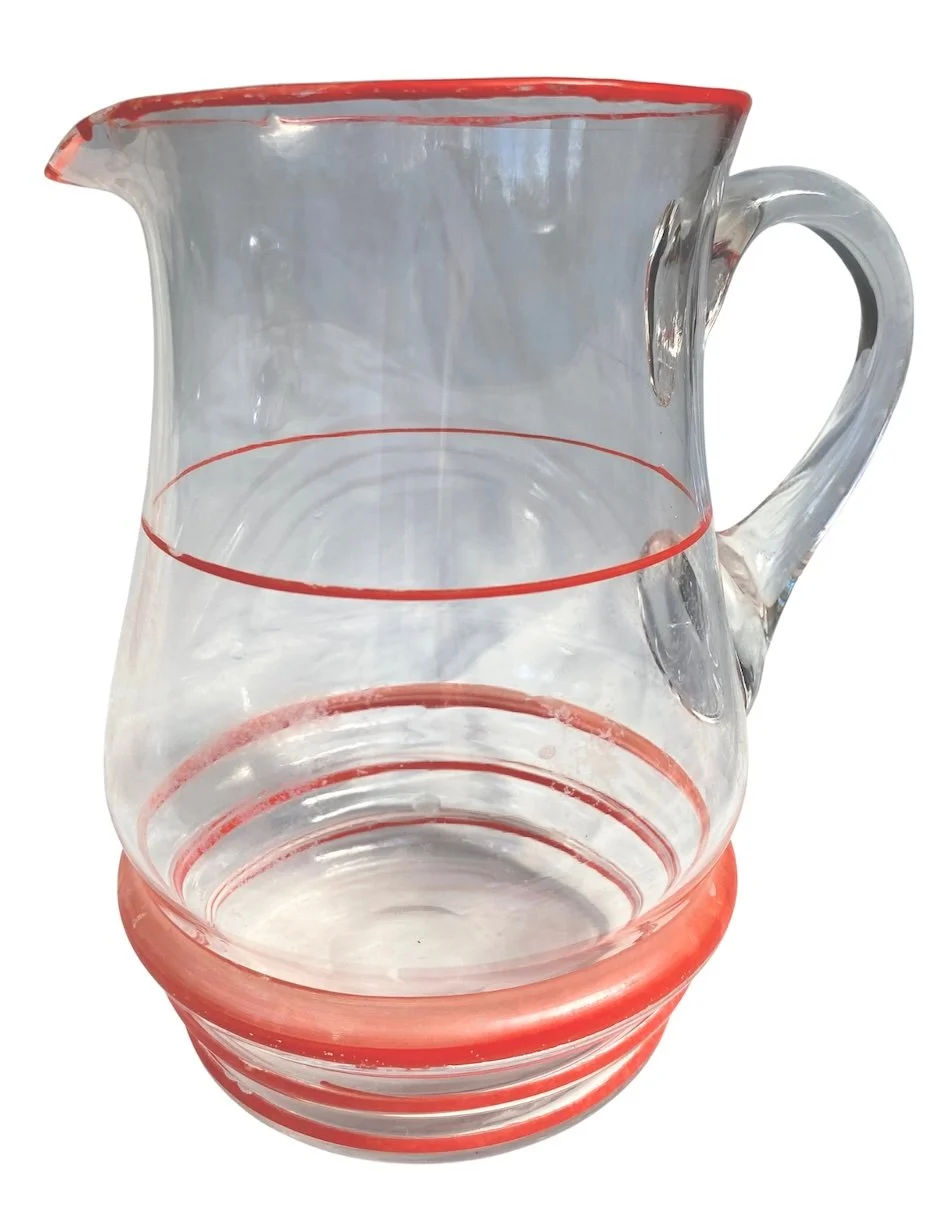
This Art Deco glass set captures the elegance of 1920s German design, where hand-blown craftsmanship meets luminous color. The pitcher features a gracefully applied handle, paired with four glasses, all adorned with pale orange-red enameled stripes.
We discovered this set in Berlin from a local antique dealer specializing in early-to-mid 20th-century household objects. The hand-blown glass is delicate, with a soft, aged surface that highlights its vintage character. While best appreciated as a display piece or with the glasses used as small vases, the set brings warmth and a subtle sense of the natural world into any interior.
The design reflects the influence of the emerging Bauhaus movement, where functionality and beauty were inseparable.
Origin: Berlin, Germany, 1920s
Materials: Hand-blown glass and paint
Dimensions: Pitcher 4.25 in x 7.5 in (11 cm x 19 cm); glasses 4 in x 3 in (10 cm x 7.5 cm)
Weight: 3.5 lbs (1.5 kg)
Condition: Good vintage condition, no cracks or chips in glass; paint has lightened and come off in parts on the pitcher and some of the glasses.
Note: The delicate nature of this aged glass makes it better suited for display or as small vases rather than drinking.

Olga de Amaral accompanies the first major European retrospective of the visionary Colombian artist, whose woven works merge fiber, light, and landscape into a language of their own. Published in conjunction with the Fondation Cartier pour l’art contemporain exhibition (October 2024 – March 2025), the book traces Amaral’s six-decade career through more than 250 photographs and essays by leading scholars and curators. Her luminous, unclassifiable art draws equally from modernist abstraction, pre-Columbian craft, and the textures of the natural world.
We first encountered Amaral’s work in Weaving Abstraction in Ancient and Modern Art at the Metropolitan Museum of Art, and again in Woven Histories at the National Gallery in Washington, D.C. but nothing prepared us for the Paris retrospective. The scale and sensuality of her gold-drenched textiles were breathtaking, each piece alive with layered histories and the quiet rhythm of handwoven time.
This volume captures something of that radiance: a tactile record of an artist whose practice transforms matter into metaphor.
About the Authors:
The catalog includes texts by Ann Coxon, textile art specialist and curator at Tate Modern; Lina Ghotmeh, French-Lebanese architect and designer of the exhibition; Marie Perennès, curator and Latin American art historian; and María Wills Londoño, Colombian researcher and curator known for her work on contemporary image and cultural narratives.
Publisher: Fondation Cartier pour l’art contemporain, Paris, France, (English edition) 2024
Format: Hardcover, 300 pages
Dimensions: 8.5 in x 11.5 in (22 cm x 29 cm)
Condition: New